cara agar cepat hamil weigh loss factor : Maret 2012

Sabtu, 31 Maret 2012

The Republican Brain

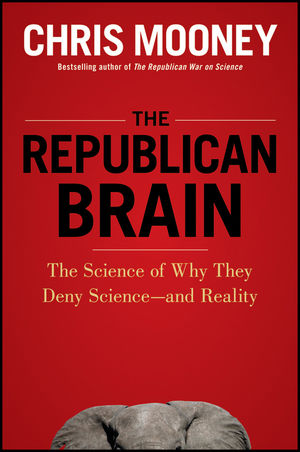
“Why are today’s liberals usually right, and today’s conservatives usually wrong?” To answer this question, asserts Chris Mooney, we need to explore “the emerging science of the political brain” (7). The result is Mooney’s latest book, The Republican Brain: The Science of Why They Deny Science—and Reality (New York: Wiley, 2012). 


Basically, Mooney sets out to explain what he sees (and has seen before) as Republican aversion to science by using the object of that very aversion–namely, various studies from the mind and social sciences. 

I won't go into too much detail on the book's argument, but a key question for Mooney is whether the split between “liberal” and “conservative” that runs through the book constitutes an a priori category of analysis and, if so, whether it’s a legitimate one. For Mooney, “conservatives” (and their opposite) are real, set apart by a deep, psychological “resistance to change,” which is tied to “less Openness to Experience (and other related traits), and helps to assuage conservatives’ fear and uncertainty about life and the world” (92). 


What you'll note is that this idea of "Openness"—one of the “Big Five” traits believed by some to constitute human personality—is itself a psychological category, one he defines as leading to “intellectual flexibility, curiosity, a willingness to entertain new ideas, and a toleration of different perspectives and values" (65). That is, “conservative” is both a legitimate social category to analyze psychologically and is itself defined in psychological terms.


If this sounds tautological, well…it is. And that tautology has a history. As Jamie Cohen-Cole has shown, the traits that cluster around Mooney’s “liberals”—flexibility, creativity, curiosity, tolerance—were brought forth by a very specific set of liberals working in the cognitive sciences in the midst of the Cold War. Research—and funding—on virtues like “creativity” exploded as part of the fight against an “authoritarian” other; political and social forces built the traits Mooney’s studies now take for granted. 


This revelation doesn't–or shouldn't–delegitimate the scientific ideas themselves. Why? As Ian Hacking and others have shown, it's the peculiar nature of the social sciences to build categories of analysis out of their purported object of study—society—and, by doing so, to change the nature of that object in turn. That Mooney finds evidence of shared psychological proclivities in a group defined a priori in (admittedly loose) psychological terms may be no fatal flaw—after all, there may be no other way.


So what's the upshot for us at AmericanScience? Mooney's analysis is certainly polemical, and there's probably a lot to doubt for experts and others, but what's new and useful is the fact that he puts flesh on the political "dispositions" and "epistemic virtues" that structure our political identities and culture. Invoking science to explain science (or antipathy toward it) is fraught with issues of reflexivity–but what account of mind or society isn't?


-------------------------------------------------------------------------
See Jamie Cohen-Cole, “The Creative American: Cold War Salons, Social Science, and the Cure for Modern Society,” Isis 100: 2 (Jun., 2009), pp. 219–262.

Rabu, 21 Maret 2012

Weight Loss Secrets

Weight Loss SecretsLose weight without exercise
Secrets to curb hunger
Shrink your tummy 50% faster
Snacks that keep you full
...and more

Price: $2.99


Click here to buy from Amazon

Jumat, 16 Maret 2012

Upcoming Northeast Regional Environmental History Conference

I'm passing along an announcement for a regional environmental history conference that will be held next month at Yale. Registration is requested but free.

Two Kingdoms: New Perspectives on Flora and Fauna in Environmental History
A Northeast Regional Conference
Yale University, Saturday, April 14, 2012
Burke Auditorium, Kroon Hall
195 Prospect Street
New Haven, Connecticut

The lineup of papers includes quite a few history of science and technology topics (as one would expect for an environmental history conference): forest and species conservation, plant and animal breeding, industrial agriculture, animal experimentation, and others. The abstracts for the conference are available here, and I've copied the schedule for the day-long event after the jump. I hope to see some of you there!

“Two Kingdoms: New Perspectives on Flora and Fauna in Environmental History.”
A Northeast Regional Conference
Burke Auditorium, Kroon Hall
Yale University, Saturday, April 14, 2012
New Haven, Connecticut
9:30
Opening Remarks
Paul Sabin, Yale University
Eric Rutkow, Yale University
9:45-11:00
Panel 1: Resource Conservation
Chair: Peter Perdue, Yale University
John Lee (Harvard): "Protect the Pines, Punish the People: The Social Implications of Forest Conservation in Pre-Industrial Korea, 1600-1876"
Rebecca Woods (MIT): "The Return of the Native Breed: Place, Belonging and Hereford Cattle in Britain"
Kristoffer Whitney (University of Pennsylvania): "Domesticating Nature?: Surveillance and Conservation of Migratory Shorebirds in the 20th Century"
Commentator: James McCann, Boston University
11:00
Coffee Break
11:20-12:35
Panel 2: Wildlife, Humans and Environmental Change
Chair: Alan Mikhail, Yale University
Thomas Wickman (Harvard): "Great Snows and Big Animals: Moose and Other Ungulates on the Contested Maritime Peninsula in the Little Ice Age, 1675-1700"
Radhika Govindrajan (Yale): "Pigs Gone Wild: The Production of Wildness and Human-Wildlife Conflict in Modern India"
Nadia Berenstein (University of Pennsylvania): "They Rush Blindly at the Light at the Expense of Their Lives”: Bird Collisions, Urban Illumination, and ‘Tragedies of Migration’ in New York City and Philadelphia, 1887-1915"
Commentator: Shafqat Hussain, Trinity College
12:35Buffet Lunch (free for all registered participants)
1:45-3:35
Panel 3: Scientific Experimentation and Technology
Chair: Daniel Kevles, Yale University
Tamar Novick (University of Pennsylvanis): "Holy Cow! On Milk Yield, Fertility and the Creation of Plenty in Palestine/Israel"
Helen Curry (Yale): "King-sized Cabbages and Miracle Marigolds: Creating Crops and Flowers with a Chemical, 1937-1950"
Sarah Sutton (Brandeis): "Rethinking Land and Labor: Shifting Family Values and the Transition to Industrialized Dairy Farming in New England"
Shira Shmu'ely (MIT): "'The Flying Death': Curare Travels From American Jungles to the British Laboratories"
Commentator: Sarah Phillips, Boston University
3:35
Afternoon Refreshments
4:00-5:15
Faculty panel
Nancy Jacobs, Brown University
Aaron Sachs, Cornell University
Harriet Ritvo, Arthur J. Conner Professor of History, MIT
Moderator: Rachel Rothschild, Yale University


Senin, 12 Maret 2012

Top 10 Weight Loss Myths - Don't Fall Victim to Them

Top 10 Weight Loss Myths - Don't Fall Victim to ThemWarning: Studies show obesity may soon overtake tobacco as the leading cause of death in America.

"Who Else Wants To Quickly Lose 10 Pounds Over And Over Again?"

You've been putting it off too long.

Hey, everyone needs to lose weight from time to time. You're no different! The world is over-saturated with temptation. With a McDonalds or Burger King on every corner, how is one supposed to keep the weight off? And now that technology has become so advanced, we're starting to have less and less opportunity for physical activity.

What is one to do? Stop eating? Work out three times a day! NO!!!

There is something you can do about it, however. Are you ready? Here it comes... What you need are...

Are you ready to drop those extra pounds you've been carrying around?

Awesome. But let me tell you something before others get to you... Two things: You don't need to jump on any current diet craze and you don't need to start exercising for hours each day. Just ask your physician. Any physician worth her salt will tell you that it's not about dieting, it's about reshaping your lifestyle.

If you want to start losing weight, just slightly tweak the habits you are already used to. Eat, but eat different. Don't sit when you can stand. They are little things, but...

...it's the little things that make up the extra inches around your waist line!

"Give me 15 to 20 minutes and I'll show you how to get results you can measure... by your waistline!"

If you've got 15 minutes, you've got time. "101 'Everyday' Tips for Losing 10 Pounds!" is a thoroughly researched report on 'everyday ways' to maintain a healthier lifestyle for people on the go. It is designed to be quick and efficient

* Learn how to best use the effects of drinking water to help you lose pounds.


* Learn the 2 most important concepts for losing weight and keeping it off.


* Understand why drinking plenty of water is so important.


* Discover which popular fruits will fill you up without adding too many calories. Not all fruits are created equal!


* Find out which drinks you should stay away from - it's not just soda pop!


* Learn what not to do with your vegetables before you eat them.


* Understand why fiber is so important and why you need to eat more of it.


* Learn which vegetables to avoid and which vegetables to savor.


* Learn what vegetable you should be eating every day.


* Learn to let your dog lead you on your next walk.


* Learn a simple exercise you can do anywhere at any time of day to burn extra calories.


* Discover the correct intensity level for your beginning workouts... it's a lot less than you'd think.


* Learn a simple technique that will continue to motivate you to lose weight.


* 7 common exercises and the number of calories you can expect to burn during each.


* And much much more!!

"Who else wants to benefit from a healthier lifestyle?!"

Listen... The pounds can sneak up on you, that's for sure. But it's often the little things that are really adding up. You didn't gain five pounds because you had chocolate cake after dinner last night - you gained five pounds because you've been eating the wrong snacks between meals for the last month.

I've put together "Lose 10Pounds Quick" with TONS of tips for you to start implementing right away. Browse through this ebook in 15 minutes and select a few tips to make your habits tonight. In a couple of week's time, your friends may start to notice that you are looking thinner.

In just two weeks, it can start to happen!

Price: $0.99


Click here to buy from Amazon

Sabtu, 10 Maret 2012

JAH Reviews (Dec. 2011)

I'm interested in thinking about the ways that history of science wins a place in broader conversations in American history. As part of my investigation, I've been skimming book review sections of JAH and similar journals. I thought you all might benefit as well from an abstract for each of the reviews published in Dec. 2011 that struck me as dealing with HOS in a significant way. Reviewed works include Philip Mirowski's Science-Mart, Nick Cullather's Hungry World, and Andrea Wulf's Founding Gardeners.

Read past the break for more.


Science-Mart: Privatizing American Science. By Philip Mirowski. Cambridge: Harvard University Press, 2011. Reviewed by Cyrus Mody.
Notes: "Part history of economics, part history of science, part lament for the decline of American academia, Philip Mirowski's Science-Mart is an enlightening, engaging, sometimes maddening tour through the 'Temples of Mammon' that Mirowski believes universities have become. Science-Mart begins by surveying economists’ evolving views on the organization of science." Mirowski also offers a periodization of American science that I'd like to explore more at some other time.


The Hungry World: America’s Cold War Battle against Poverty in Asia. By Nick Cullather. Cambridge: Harvard University Press, 2010. Reviewed by Robert J. McMahon
Notes: Cullather wrote a terrific article on the "Foreign Policy of the Calorie" a few years back. This is the bigger book that he was writing alongside that article. "Indeed, in one of his signal contributions, Cullather explodes the popular myth of the transformative 'Green Revolution.' He depicts the oft-told tale of “miracle” wheat and rice strands averting starvation and spurring spectacular agricultural growth in postwar Asia as a comforting story constructed by self-interested actors that bears little resemblance to actual occurrences."

Pox: An American History. By Michael Willrich. New York: Penguin, 2011. Reviewed by Howard Markel.
Notes: "Perhaps Willrich's most important contribution to this burgeoning literature, however, is his superb analysis of the legal and individual rights involved in public health programs that mandate vaccination for the greater good even over the objections of individuals who desire to opt out of such interventions. Pox is a sweeping account of how mass smallpox vaccination programs helped contribute to the development and growth of such federal agencies as the U.S. Public Health Service, the Centers for Disease Control and Prevention, and the National Institutes of Health, along with the rise of municipal and state health departments."

Founding Gardeners: The Revolutionary Generation, Nature, and the Shaping of the American Nation. By Andrea Wulf. New York: Knopf, 2011. Reviewed by Kim Kleinman.
Notes: "In 1787 a visit by several key delegates to Bartram’s Garden in Philadelphia during the Constitutional Convention helped break a deadlock around representation in the legislature." Kleinman compares it to Phil Pauly's recent, great book: "Pauly’s book, however, is more comprehensive, sustained, and challenging, arguing that “From the early nineteenth century onward, horticulturalists reasonably argued that [their] high culture … would lead to higher culture—to the refinement of public taste” (Pauly, Fruits and Plains, p. 6). But Wulf’s is a fine, engagingly written book, with eighty pages of notes and an extensive bibliography, that shows how the 'founding gardeners,' as gardeners, shaped the American nation"

Passing Strange: A Gilded Age Tale of Love and Deception across the Color Line. By Martha A. Sandweiss. New York: Penguin, 2009. Reviewed by Kenneth R. Janken.
Notes. I've talked about this before. "Martha A. Sandweiss excavates King's well-documented life and offers informed speculation about Ada Todd, whose appearance in the historical record is scant....Though most racial passing went in the other direction, the author historicizes meanings of race and the mutability of identity."

Paranormal America: Ghost Encounters, UFO Sightings, Bigfoot Hunts, and Other Curiosities in Religion and Culture. By Christopher D. Bader, F. Carson Mencken, and Joseph O. Baker. New York: New York University Press, 2010. Reviewed by Sarah M. Pike.
Notes: Thinking about some alternative ways of knowing--- "Bigfoot hunters, haunted houses, psychic readings, and unidentified flying object abductees are common in “paranormal America,” a world that includes a diverse spectrum of ordinary people...But historical depth and nuanced analysis aside, Paranormal America is entertaining sightseeing in a world that is often trivialized by academics, and readers will at the least come away with a glimpse of its complexity"

Measuring America: How Economic Growth Came to Define American Greatness in the Late Twentieth Century. By Andrew L. Yarrow. Amherst: University of Massachusetts Press, 2010. Reviewed by W. Elliot Brownlee.
Notes: Why do we care about GDP? I have wondered about this before. "Andrew L. Yarrow reaches two key, intertwined conclusions in this book. The first is that “Beginning in earnest in the postwar era, opinion-shaping elites in politics, business, academia, media, schools, and public diplomacy gloried in America's ever-growing economy as the ‘measure of the nation’” (p. 2). The second conclusion is that “Economic ideas came to have vastly greater influence on American culture” as they “dovetailed with” the assertions of elites that “the meaning and value of the United States increasingly resided in its growing, quantifiable abundance” (p. 3)."


Rabu, 07 Maret 2012

HOS in the EASA

[UPDATED]
I'm on the lookout for history of science or science studies topics escaping into US history or American studies venues and publications. Please send me leads as you find them. I'll shortly be posting links to recent HOS-related book reviews from past numbers of the Journal of American History.

For now, I spotted a couple interesting papers at the Eastern American Studies Association meeting at Rutgers on March 30-31. Read past the jump for an abstract of Kathleen Brian's paper, part of a project on the history of suicide and eugenics. [I have also added an abstract from Arjun Poudel.]

These were the two papers that caught my eye:
Kathleen Brian, ““The Suicide Contests”: Metasomatization in the Life Insurance Industry, 1862-1883”;
Arjun Poudel “Minor Science, Major Literature: Melville’s Scientific Method in Moby Dick”.

Kathleen Brian, a graduate student at George Washington University with a fascinating dissertation that will "offer an alternative genealogy of American eugenics by focusing on debates about suicide from the 1850s to turn of the century" sent me the abstract for her paper. Here it is:

“The Suicide Contests”: Metasomatization in the Life Insurance Industry, 1862-1883
This paper argues that the ancestral body of suicides as a tool of insurance underwriters emerged in response to the legal successes of beneficiaries, who increasingly pathologized suicide in their pursuit of policy payouts. To make this argument, I analyze the suicide clause in life insurance policies as it circulated within industry journals, company advertisements, and federal court cases. Meant to exclude claims when death occurred as a result of “one’s own hand,” the suicide clause became the nexus of heated legal debates during the 1860s and 1870s. These debates focused on property forfeiture, familial responsibility, and the potential criminality of self-destruction, but were embedded in a hereditarian discourse that also allowed insurance companies to perfect their technologies of metasomatization, such as the family history. While Foucault developed his concept of metasomatization most powerfully through an analysis of psychiatric discourse and praxis, the suicide contests demonstrate that this phenomenon was very much at play in federal courtrooms. In their legal arguments for federal protection, insurance companies juxtaposed the diseased ancestral body of suicides against two additional ancestral bodies of their own creation. The first of these was the ancestral body of healthy, industrious American policyholders; the second, the ancestral body of the insurance corporation itself. Through this juxtaposition, insurance companies ultimately succeeded in laying claim to federal protection. The suicide contests thus illuminate new ways in which categories of (dis)ability and (ill)health solidified at the intersection of finance capitalism and the federal state.

Arjun Poudel, a grad student in English at Northeastern, works on " Anglophone post-colonial writing, Herman Melville, and 20th-century British and American novel." I'll post his entire abstract below, but I'll highlight the bit that interested me most:
In late 1830s, Melville was enrolled in Lansingburg Academy in New York, near Albany, where he received formal training in engineering and geographical survey techniques, and also got some exposure to Linnaean taxonomy. Again, this crucial part of his career (unlike Melville’s experience as a mariner, his relationship with his father-in-law judge Lemuel Shaw, and their influence in his work) hasn’t received more than a passing reference in some biographies, let alone its impact in his work.

Here's the entire abstract:

Minor Science, Major Literature: Melville’s Scientific Methodin Moby Dick
-Arjun P. Poudel
“There are some enterprises in which a careful disorderliness is the true method.”
-        Herman Melville, Moby Dick
A group of mostly European paleontologists have published a series of letters (an academic genre regularly published in journals like Nature) and articles in natural science journals reporting the finding of many new species of whales in the last 2-3 years. This flurry of publications has followed the scientists’ visit in 2008 to a region in Peruvian south that hosts deposits of thousands of whales’ and other marine animals’ fossils and is therefore regularly frequented by such scientists. One research report, however, became a news sensation and found its way down the supply chain to the popular science magazines as well as a large number of daily news media. The sources of the species and genus names chosen for the taxonomical christening (a form of antonomasia) of this new species of sperm whale Leviathan Melvillie, I will argue, were to an important degree responsible for the publicity generated by the report.  Admitting that they were all fans of Herman Melville, the paleontologists had abdicated the chance to immortalize themselves or someone from their own field (as they have historically done) and chosen the US novelist and his fictional species Leviathan described by Ishmael in a geologist’s guise, using Vesuvius’s crater as an inkstand, in the crucial Chapter 104 in Moby Dick.
In Deleuzian terms, this international group of paleontologists representing many of Europe’s world famous natural history museums can be viewed as quintessential state apparatus or apparatus of “royal science” which he contrasts with “minor science,” and their appropriation of the name and work of a 19th-century itinerant writer and mariner for the publicity of their own work clearly exemplifies what Deleuze calls the “abduction” of the nomadic and accomplished “minor science” by lazy and sedentary “royal science.” Does Moby Dick then represent a minor science, minor literature or a minor cultural practice comparable with the works that Kafka wrote in the “sub-standard” German of the Prague ghetto?
            This paper seeks an answer to this question by examining the multiple scientific and geometric methods and motifs employed by Melville in several crucial chapters of Moby Dick. Of particular importance, in this regard, will be (besides the geological point of view used in the above-mentioned chapter 104) the cetological taxonomy employed in much of the novel, the circle that cannot be squared (chapter 80), the conical grandissimus (chapter 95), cycloidal horology (chapter 96), and what is today called “complexity theory” in chapter 61 in which Stubb kills a sperm whale. These methods and motifs receive a much more serious treatment than the numerous pseudo-sciences like craniometry, phrenology, and physiognomy that were quite popular in the 19th century and that Melville discusses in some cetological chapters only to dismiss them soon afterwards. My contention, here, is that Ishmael is a minor scientist without a faith in his craft’s effectiveness, because he is not only skeptical of the scientific method that he employs so effectively and with good judgment, but also imposes the legal grid (striated space, in Deleuzian terms) of some unifying chapters (such as chapter 45 entitled “Affidavit”) upon the “smooth” space of the cetological and many other chapters that cluster around the unifying ones in the novel. 
Ishmael refers at several points in the novel’s narrative to his “method” and “methodical” approach (the quote above is from chapter 82) to the study of Whaling that is clearly inspired by the rationalist more geometrico of early Enlightenment. And yet, this crucial aspect of his narrative technique has not received much treatment in the gigantic body of critical work on this giant of a novel. In late 1830s, Melville was enrolled in Lansingburg Academy in New York, near Albany, where he received formal training in engineering and geographical survey techniques, and also got some exposure to Linnaean taxonomy. Again, this crucial part of his career (unlike Melville’s experience as a mariner, his relationship with his father-in-law judge Lemuel Shaw, and their influence in his work) hasn’t received more than a passing reference in some biographies, let alone its impact in his work. This paper hopes to fill a part of this gap in Melville criticism.
 

Minggu, 04 Maret 2012

How to Eat Right and Manage Your Life: Master The Art Of Controlling Your Appetite & Live An Abundant Life! AAA+++ (Brand New)

How to Eat Right and Manage Your Life: Master The Art Of Controlling Your Appetite & Live An Abundant Life!  AAA+++  (Brand New)Are you eating just to whet your appetite or to satiate your taste buds? Or are you eating in order to take better control of your life?
In this eBook, we see how you can make your life much more optimal just by making sure that you eat right.

Table Of Contents

Chapter 1:
Why We Face Health Problems Today

Chapter 2:
The Solution

Chapter 3:
What Is an Ideal Diet?

Chapter 4:
Benefits of Eating Right

Chapter 5:
Losing Weight by Eating Right

Chapter 6:
Eating Right Is Not the Only Thing

Chapter 7:
Managing Food, Family and Friends

Chapter 8:
Your Motivations for Eating Right

Chapter 9:
How Not to Become Obsessive about Eating Right

Chapter 10:
Eating Right and Managing Your Life

-------------------------------------------------------------------------------


Dear Readers:

We are dedicated to providing our customers with cutting edge information with the latest and most popular ebooks & hot topics at very affordable prices. Our mission is to create positive change in your life. We carry hundreds of unique titles including "Literary Classics" under many categories for your convenience. Please click on the name "Manuel Ortiz Braschi" at the top of the page, next to the title, or write "Manuel Ortiz Braschi" at the search box and you will be taken to our main page in Amazon, where you will be able to check all the interesting, unique and informative titles that we carry at Amazon Kindle.

Price: $2.99


Click here to buy from Amazon

Sabtu, 03 Maret 2012

Science and Method in the Humanities

I spent last Friday at a conference on "Science and Method in the Humanities," sponsored by the Rutgers British Studies Center, among others. Hats off to the organizers for putting on a stimulating, well-run event – lots to think about for scholars of all sorts. 


As Carin Berkowitz pointed out, the day's conversation seemed to proceed at two levels. On the one hand, there were epistemic questions about how various methods fit together; on the other, there was disciplinary anxiety about the current state of the academy.  

Of course, we all know that these two sorts of questions are inextricably linked (cf. "Hobbes was right."). But how? First, as Barbara Herrnstein Smith, disciplines coalesce not around methods but around questions, to which different methods are suited. For her, this is the basis for the plurality of available methods and the continued persistence of "the humanities." 


Second, and more to the point, Peter Dear made clear that the idea of a unified "scientific method"(as distinct from a method that was "scientific") emerged in the nineteenth-century as part of a project of demarcating "science" from other pursuits. Elucidating a unified "method" produced a guarantor of knowledge that could be put to use in the social world. 


It's an open question whether "method-talk" (as a sort of "Holy Ghost" unifying the various sciences) can be broken down into the separate spheres of guiding practices within a science and enabling certain forms of distinction between science and something else (the public, for example, or "the Humanities"), the answer to which depends on what you want to know. 

The "Digital Humanities" are (or were treated to be) a case in point: in one sense, they borrow the methods of "science" to answer questions from the "humanities"; in another, the two–methods and questions–bleed into one another. What is the politics behind using new methods for old questions, and what can this tell us about ongoing shifts in the epistemic virtues of the modern academy?