cara agar cepat hamil weigh loss factor : November 2012

Kamis, 29 November 2012

Celebrating the 50th Anniversary of Thomas Kuhn's The Structure of Scientific Revolutions at the University of Chicago

I just arrived in Chicago where I will be attending a conference on Thomas Kuhn's The Structure of Scientific Revolutions at the University of Chicago beginning tomorrow. The event is jointly sponsored by the University of Chicago Press, the Fishbein Center for the History of Science, and the Max Planck Institute for the History of Science. I have rarely seen a conference with a more promising line up (the program is here), and I'm really looking forward to it. (There's also a rumor that a certain other member of this blog, who happens to be a postdoc at Northwestern University, might also be there tomorrow. I hope he is!!)

I'll be live-tweeting at least portions of the event. Follow me at @STS_News. And look for a summary of the event soon here on American Science.
 
Kuhn!!!!

Jumat, 23 November 2012

After Construction/Between Loops and Kinds: Alexander's The Mantra of Efficiency

My favorite thing about this blog is that it sticks things deeply in my craw, and I cannot pull them out, so now my craw is full. Today, I'd like to return to a discussion we were having several months ago about ontology (here, here, here, and here). It's never let me go. I'd like to return to it by considering Jennifer Karns Alexander's 2008 book, The Mantra of Efficiency: From Waterwheel to Social Control


The Mantra of Efficiency won the Society for the History of Technology's Edelstein Prize, for "an outstanding scholarly book in the history of technology published during the preceding three years." Like all Edelstein-winning books, Mantra was the subject of a special conference session, this one at SHOT's 2010 meeting in Takoma, WA, which included commentators like Bill Storey, Wiebe Bijker, and Tom Misa. At one point, the discussion took an unexpected turn. Misa said that Alexander's account of efficiency pointed to a post-constructionist history of sci/tech. This excited Misa (and me!). Bijker pushed back, standing up for the continuing relevance of constructionism, which he did again this year when he accepted the DaVinci (lifetime achievement) medal at SHOT's 2012 meeting in Copenhagen. Alexander, I think, did not want to wade into these dangerous waters and, as I recall, was hesitant to say that her book meant to go there. But I agree with Misa: Mantra does go there—or at least it points one way.

First off, The Mantra of Efficiency is a good book, and everyone should read it. It has crossover interest for historians of science and technology and shows a way forward in bridging that divide. If I bumble things with my butter fingers in what follows, you should not blame it on the book. Second, I'm going to give a brief account of Alexander's overall argument, but I am centrally interested in her theoretical framework, which is contained in her intro and conclusion. Moreover, although I'm interested in Misa's point about post-constructionism, I'll spend most of my time at the end using Alexander's account of efficiency to question Ian Hacking's distinction between "natural kinds" and "human kinds," which we've already tackled here in those posts on ontology I listed above.

Alexander covers the emergence and transformation of efficiency across considerable time (1750 or so to the present) and space (the US, UK, and France to the globe) by way of several case studies. (The book's form is not unlike Daston and Galison's Objectivity in that way.) Alexander is fascinated by efficiency's dual nature: there are static and dynamic visions of the notion; it is simultaneously descriptive and normative. This quotation captures the idea's double image, "At times [efficiency] emphasizes stability and conservation; at other times it is embedded in a rhetoric of transformation. It appears to be merely a technique of quantification, yet it also appears as the goal towards which quantification is employed. It can be both a model of a well-controlled process and a tool to help achieve that control." (4)

These thoughts lead Alexander to look near and far for the workings of efficiency. She shows how Darwin and Marshall used the notion to discuss, respectively, evolution and markets, and she examines how Taylorists and others used efficiency to remake work. When she talks about the latter cases and describes her own negative experiences with efficiency, Alexander almost sounds like a member of the Frankfurt School criticizing "instrumental reason." Almost but not quite—she's more timid in her moral judgment. (This issue reminds me of Adam Curtis's [highly problematic] history of how we've used machine metaphors to describe nature.)

Chuck Darwin: "natural selection [is] . . . efficient in so high a degree."
In her search for a way to describe efficiency's history, Alexander tries to clear away some previous ways of dealing with similar notions, which she thinks are problematic: "The temptation, when confronted with such a broad array of uses [of the word], is to treat efficiency in one of three ways: as the product of a specific localized context, as the metaphorical application of an engineering term, or as one among many instances of quantification." (4) Anyone attuned to the historiography of sci/tech will see that Alexander is taking swipes at some heavies—and questioning some constant themes (theories? concepts?): local knowledge, metaphor, and quantification/numbers.

This post is already going to be long, so I need to be as brief as possible here: I think that Alexander's book forms part of a critique of the dogmas of science and technology studies, which I hope to outline here and in some white papers over the coming weeks and months.

There is good reason to doubt the STS dogma that all knowledge is local, just as it is irresponsible to teach uncritically works, like Donna Haraway's essay "Situated Knowledges: The Science Question in Feminism and the Privilege of Partial Perspective," without seriously interrogating their assumptions in front of students.  For instance, you could say that Srinivasa Ramanujan would not have begun working through mathematics if it wasn't for local contexts. These local contexts would include his private life as well as the colonialism that brought books, like S. L. Loney's works on trigonometry, to his door. But this isn't saying much of anything at all. It doesn't help us determine whether his math was any good, nor does it help us understand why he was able to rediscover mathematical principles that weren't in such books. This brings us back to the old criticism, which holds that STS too often puts all of the causality on the side of the "social" rather than also copping to the force of ideas themselves. And this is Alexander's point, "Subsuming efficiency in context suggests that it is a shell, ready and waiting to take on the values and objectives of whoever uses it but with little content or character of its own."

We should also follow Alexander in questioning the academic love affair with "metaphor." (Trace the "metaphor" and "rhetoric" entries in the index of Zammito's A Nice Derangement for a good time.)  The metaphor of "metaphor" in cultural history is a good example of finding a partial truth and running with it. Are some statements and image in science metaphorical? You bet. But just as Ludwig Wittgenstein could list many different uses and goals for language (aphorism 23 here), statements and images in science play many different roles. (Sergio Sismondo has tried to create a varied account of scientific propositions and images, in his case maps, here.) For instance, if I decide to stock my farm with Hereford cows because they use calories more efficiently than Holsteins, am I somehow enacting a metaphor? That makes no sense to me.

Alexander's reason for saying that efficiency is more than metaphor sounds a lot like her point about context, "Speaking of metaphor suggests that efficiency has no substantial content of its own when used outside of the physical, material domain of engines and energy. Treating efficiency as a metaphor sidesteps the thorny question of how a technical concept might effectively be applied in nontechnical circumstances and undermines the possibility of recognizing serious attempts to extend a powerful and generalizable concept beyond the boundaries of physics or engineering."

Fred Taylor: All-Around Good Guy, Graduate of Stevens Institute of Technology. Woot!

Alexander does not say a great deal about why quantification is a bad way to view efficiency; neither will I. But the important points are captured in the bit I just quoted: quantification is an essential part of the technical definition of efficiency, but the term has become more than technical and is used qualitatively in all kinds of circumstances, including everyday life.

While Alexander deals with the pre-modern history of efficiency, including cameos by Aristotle and Aquinas, I think she wants to claim that efficiency rose above local contexts and spread so far in the world because it was/is so central to modernity and modernization. (Do you smell Adorno and Horkheimer skulking close?) This account itself can feel a bit dated, since many people have moved beyond interest in modernization theory and have become massively bored with postmodernist ramblings about modernity. But I think that some very interesting questions lurk here, and everything Alexander says could be brought inline with currently fashionable topics and movements, like the NEW HISTORY OF CAPITALISM (for our account, see here and here). Along these lines, I would have liked to have heard whether Alexander thinks, like Frederic Jameson, that there is A Singular Modernity (read "capitalism"), or if she is more of a multiple modernities-type thinker. This distinction has important implications for how we think about and describe efficiency.

Just for the record: the #1 image in a Google Image search for "efficiency"
Now to turn finally to Ian Hacking: in our previous discussions about ontology, we focused on Hacking's distinction between natural and human kinds. Hacking says that there is something special about human kinds—such as ideas about sexuality, mental health, race, etc.—in that they "loop" back and end up affecting human behavior. He believes this means that there is something particularly historical about human kinds that doesn't apply to natural kinds (electrons, species, skeletal structure, you name it). We historians at American Science were all in agreement that natural kinds are more historical than Hacking claims, though we did not sort out what this means before we ran out of steam.

I want to assert tentatively that the notion of efficiency (as Alexander explains it) calls into question Hacking's human vs natural distinction: efficiency is irretrievably and simultaneously natural and human (in Hacking's sense; does this mean something like descriptive and normative?). No one would doubt that efficiency is a human kind or that it doesn't "loop." The idea has completely remade human life and work over the last 150 years. Yet, it's a also a term we use to describe natural processes, including, for instance, digestion. Some people might want to say that such descriptions are "just metaphor." I don't think we want to go that route. Efficiency has a great deal to do with how species find, assimilate, and use calories, and (we think) it plays an important role in evolution. If that's not "real," I don't know what is.

Now, I could be getting into problems all throughout this post, but I am most aware of possible confusion right here. Lukas wrote about debates over whether dinosaurs had feathers. Perhaps we want to say that dinosaur feathers are a "natural kind" in a way that the efficiency of a biological process is not. Perhaps we want to insist that natural kinds pick out things, not processes. I might allow that, but I don't think that this assertion would deny that efficiency poses problems for Hacking's natural vs human kinds. It would just mean that we need to come up with a third kind altogether. I lack the vocabulary and theory to sort this matter conclusively. If someone wants to tell me why processes are or aren't natural kinds or desires to make a case for Hacking, please do. 

Regardless of how this theoretical discussion shakes out, The Mantra of Efficiency helps us question received wisdom in STS, including the history of sci/tech. For that as well as its lovely case studies, we all need it.

Rabu, 21 November 2012

The Other 2012 Prophecy

I asked Joseph November, Associate Professor of History at the University of South Carolina, to share this techno-prophesy with our audience. He was kind enough to oblige me. Enjoy! (If you want to read more, check out his new book):

Closing in on December 21, 2012, there are few credible signs of the prophesied apocalypse. However, there’s another set of 2012 predictions, one pertaining to the use of electronics in medicine that just might be worthy of your notice.
Lusted's 1962 Paper, as reprinted in 2000
In “Bio-Medical Electronics-2012 A.D” [pay-wall], Lee B. Lusted, M.D. imagined he was writing a letter to his 1962 Proceedings of the IRE audience from fifty years in the future. In his short but captivating essay, Lusted, a radar engineer-turned-radiologist who at the time headed the National Institutes of Health’s first effort to computerize biology and medicine, set forth his vision of what medicine would be like in the future he was helping to build.

Besides offering fascinating benchmarks for both providers and consumers of medical care, Lusted’s speculations provide us with a window into the thinking of one of the most influential, though seldom-discussed, shapers of today’s medicine.

Writing to 1962 from his envisioned 2012, Lusted made the following observations:


  • "Nearly all of the body organs can now be replaced by compact artificial organs with built-in control systems. This includes the heart, kidneys, stomach, and even liver…. The ability to find the correct nerve circuits and to trace the circuit like a telephone repairman was developed in the early 1990's and it is this technique, made possible by microelectrodes and very compact flexible computers, which permits the quick hook-up of artificial organs."
  •  "Long flexible fiber optic bundles can be inserted into any body orifice and also into arteries and veins so that the physician can look around inside any organ in the body…The old unsolved problem of the 1960's of trying to find a small bleeding vessel in the small intestine is easily solved now because the surgeon can look around inside the intestine, with one fiber scope and simultaneously inspect the blood vessels to the intestine with a fiber scope which he has inserted into the blood vessel system."
  •  "Micro chemical analysis, high speed computers, the extensive use of information theory and recently developed new mathematical techniques now help identify the exact composition of the nucleic acids and a host of enzyme systems."
  •  "The position of the chemical constituents such as amino acids in all of the complex chemical systems is now known. It is also possible with about a 90 per cent probability of success to replace any defective amino acid within a nucleic acid. This technical development has made it possible to develop a superior system of genetics. Genetic defects which were unavoidable in the twentieth century can now be avoided, or if they do occur they can be repaired… parents can now choose to have a boy or a girl (with about 90 per cent probability of success)."
  •  "The early bio-medical computing systems and electronic diagnosis systems developed in the United States were sent to other countries, such as India, Africa and South America where they were very helpful to the few available doctors who were trying to look after the health of large populations."
  • "By 2000 A.D. people have become accustomed to the regular health checkup most of which they can have in their own homes. On a given day at an appointed time the person goes to some room in the house where equipment has been installed and connected to the local medical center."


It’s hard not to read through Lusted’s imagined report from 2012 without a knowing smile or a twinge of regret, but what should not be forgotten is that Lusted was writing in earnest and from the perspective of someone who was in a position to channel federal funds towards the development of the wondrous advances he predicted. Granted, many aspects of the future Lusted imagined did not come about, but this was not for a lack of trying or resources.

In my new book, Biomedical Computing: Digitizing Life in the United States (Johns Hopkins University Press, 2012), I show how Lusted’s widely influential computing advocacy (often written in collaboration with Robert Ledley, the inventor of the whole-body CT scanner) and his actions as chair of the powerful NIH Advisory Committee on Computers in Research during the early 1960s laid much of the groundwork for the computerization of biology and medicine. Computer-dependent biomedical endeavors like the Human Genome Project and Evidence-Based Medicine have many roots that can be traced to Lusted’s vision and patronage. The book also makes the case that Lusted and his fellow visionaries at the NIH sponsored work that helped to bring about major changes in computing itself, including the development of personal computers.

[I thank Dan Bouk for giving me the opportunity to share this story here!] No, Joe. Thank you!

Selasa, 20 November 2012

The Fall of Jonah Lehrer (Part 3 of 4)

This is the third installment of a four-part series on the cultural context of contemporary popular science writing. Part I is here, Part II is here, and Part IV will appear next week. 

The first decade of the new millenium put the big—as in big money—in "Big Ideas." From The Tipping Point (2000) to Freakonomics (2005) to Ted Talks (which started streaming in 2006), an intellectual economy emerged that put a premium (and a price) on counterintuitive conclusions.

Source: http://www.thedailybeast.com/galleries/2012/08/01/jonah-lehrer-david-brooks-and-other-malcolm-gladwell-wannabes-photos.html#

In many ways, this was what I called "the house that Gladwell built" in my first post. However, my second post suggested a more structural explanation for the sort of popular science peddled by Malcolm Gladwell and what one source has called "the Gladwell clones and wannabes who specialize in writing counterintuitive books that explain the world."

Let's flesh this out a bit further. When people "copy Malcolm Gladwell," what exactly are they copying? Is it different if the person in question is a journalist, a scientist, an academic, or none of the above? With specific reference to Jonah Lehrer, is there something about his position vis-a-vis Gladwell (e.g. in the image above, or as heir apparent) that set him up for the fall that spurred these posts?

What's so special about Gladwell? It's not (just) his writing: though he's got a way with words, so do tons of others—some of whom also get jobs with the New Yorker. Though there's certainly a market for the artful rendering of difficult, technical topics—witness the rise of Nate Silver—I don't see Gladwell as better enough than the competition to justify his earnings on that alone.

Nor is it what we might call "the ideas themselves," since—famously—they're not his own, but rather (as Steven Pinker put it) "counterintuitive findings from little-known experts" (more on expertise in a second). In reality, it's probably some combination of the two: it's these particular ideas, packaged in this particular way, that's made for a winning combination (and million dollar advances).

This seems right, but it leaves unexplained what precisely "these ideas" are and why there's such a market for them now. Oh, and what did Malcolm Gladwell have to do with it? It happens that many would agree with Ross Douthat's "quotation" (you see the irony) of Allen Ginsberg on the matter:

Douthat on Lehrer (Source: https://twitter.com/DouthatNYT/status/230319900135137282)

Okay, but how? If New York was even partly right to say that, in the last decade, "the shocking hidden side of everything became the only side of anything worthy of magazine covers and book deals," then does Gladwell deserve credit or was it just "right place, right time" (an argument Gladwell himself prefers)?

One interpretation I like is that Gladwell's "non-threatening answers" were timed perfectly. The Tipping Point coincided with a real "tipping point": the dot-com bubble burst within a month of the book's appearance. We needed a sense of security and Gladwell reassured us that "our elites know what is going on, and the complexity of the world can be explained in a calm, hip, erudite way."*

This genre—into which Lehrer's work certainly fits—wasn't just about being hip and erudite. These books are about "big ideas," in the sense (according to one definition) that they "center around a counterintuitive or provocative theme" and explain "why things are not as they seem."

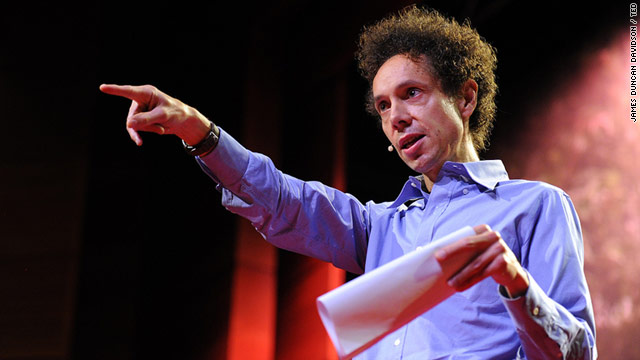
Source: http://i.cdn.turner.com/cnn/2011/OPINION/07/17/ted.global.ten.questions/t1larg.gladwell_norden_technology.jpg

Coming up with such claims is tough: hence, if you've got one, you'll probably reuse it (self-plagiarism) and, if you haven't, you might be driven to pretend that you do. Slate took this analysis to the extreme: as sales went up, Lehrer "ceased to be a writer" and "moved into the idea business": 
This is the world of TED talks and corporate lectures, a realm in which your thoughts are your product. For the idea man, the written word is just one of many mediums for conveying your message and building your brand.
"Ideas" are the way you get from writing to lecturing—in which you can sell the same ideas again and again, for prices that keep going up and up. New York Observer piece put it best: "Old model: tour the country to promote your book. New model: write a book to tour the country." 

How TED, you might say. And indeed, Lehrer's fall has been attributed to the "ecosystem" of TED, which has itself come under both probing scrutiny (by Nathan Heller in The New Yorker) and withering critique (by Evgeny Morozov in The New Republic). In this world, complexity is reduced to soundbites and data are sheered of their subtlety—often not by the scientists and innovators whose ideas are being celebrated, but by journalistic "packagers" like Gladwell, Lehrer, and David Brooks

Is this bad? Not necessarily. But it does raise another issue that's central to science studies: the nature of expertise. I'll wait til next week to get into the details of "evolutionary psychology" and the boundary-work that goes on around it. Today, let me close instead with another figure in the world of popular social science (in this case, statistics): Nate Silver

Source: http://www.esquire.com/cm/esquire/images/tU/esq-nate-silver-1012-xlg.jpg

Much (digital) ink's been spilled about Silver since the election (here's a guide)—some pronounced him the actual winner of the 2012 election, others derided his data-driven approach as a joke. What I'm most interested in is the upshot of Silver's remarkable success: political reporting will now be more data-driven, many say, and journalism in general should cultivate new experts on an old model. 

A Newsweek post called "Statisticians on the Bus" (among others) calls for a new generation of "Quant Pundits" to displace the "mile-wide, inch-deep political reporters" of yesteryear. Silver himself agrees—for example, he told Stephen Colbert that if he had the choice between pundits and ebola, he'd choose the latter

Though I'm tired (and skeptical) of the "statistics vs. narrative" framework in which this discussion's taken place, I think we have to recognize both the pull that binary has and what the stakes are in terms of who we trust. 

A recent post on Scientific American connects Silver to "the ascendence of expertise" in an interesting way. Though the politics are a bit flat-footed, the post's author correctly notes that Silver's success has ridden on a general trend at the New York Times to hire "people with real expertise" to provide commentary. 

Though some see expertise in accreditation (e.g. a Ph.D.) and others see it as self-guided exploration (e.g. long-term bloggers), it seems to be the province of hedgehogs rather than foxes. Knowledge can be wide; expertise has to be deep. What's more, the sort of stuff Silver's up to requires real statistical chops—not necessarily top of the line stuff, but enough to get by in an age of big data. 

Whether that's exactly expertise I'll leave to the reader. What I wanted to point out, by way of foregrounding my next (and final) post, is that there's something at stake in the difference between a Silver and a Lehrer—and that it's hard to figure out precisely what it is. Next week, I'll zero in on what makes Gladwell and Lehrer different from Steven Pinker and Jared Diamond.

-----------------------------------------------
*Note: Gladwell applied his trademark approach to the problem of plagiarism itself back in 2004

Rabu, 14 November 2012

#hsspsa12

I'm flying out tomorrow morning for the History of Science Society's Annual Meeting in San Diego. The philosophers of science will be there too, and the whole thing kicks off (of course) with more talking about Kuhn!

I hope all our readers at the conference will turn out for the Forum for the History of Science in America's business meeting and distinguished lecture. During the meeting we will announce the winner of the FHSA prize for the best book on the history of science in America published in 2009-2011 (look for an interview with the author soon thereafter). If you'd like to get involved in the forum in any capacity, please feel free to drop in.

After the business meeting, we can all turn our attention to James Fleming, the FHSA distinguished historian lecturer, giving a talk called "At the Cutting Edge: Harry Wexler and the Emergence of Atmospheric Science." See you all there on Friday at noon in the Spinnaker room.

Whether or not you make it to the meeting, please track me down or one our other bloggers (Joanna and Lukas will be there too) and tell us what you'd like to see more of on this blog. We would love to hear from you!

Selasa, 13 November 2012

The Fall of Jonah Lehrer (Part 2 of 4)

This is the second installment of a four-part series on the cultural context of contemporary popular science writing. Part I is here, and Parts III and IV will follow in the next two weeks.

In 2010, Jonah Lehrer wrote a widely-read New Yorker piece called "The Truth Wears Off." It began with a provocative question: "Is there something wrong with the scientific method?"

Source: http://www.newyorker.com/images/2010/12/13/p233/101213_r20317_p233.jpg
Lehrer's answer, both in the piece and in follow-ups elsewhere, was "yes." He calls the frightening failure of scientists to reproduce one another's results (or even their own) the "decline effect"—an old phrase for a new fear.

However, it's not just science that's in trouble. In the wake of Lehrer's recent travails, something seems wrong with science writing, too—big, bold claims seem unable to weather scrutiny. In what follows, I'll treat the problems facing science and science writing as parallel stories.

So, what is the "decline effect"?

According to Lehrer, the phrase was coined in the 1930s when a Duke psychologist thought he had discovered extrasensory perception (E.S.P.). However, his proof—a student able to predict the identity of hidden cards far better than chance—began to "decline" back to the level statistics would predict.

While this was seen as a drop in the student's actual extrasensory powers, we now tend to see the "decline effect" operating on data rather than the phenomena. That is, E.S.P. didn't decline over time—it never existed in the first place. Evidence to the contrary was simply smoothed out by regression to the mean.

This may seem obvious, but it's actually where things get interesting.

Jonathan Schooler—a psychologist at UC-Santa Barbara—believes we can (and must) use science itself to figure out why well-established results are failing the test of replicability. He's proposed an open-access database for all scientific results, not just the flashy, positive results that end up in journals.

http://www.nature.com/news/2011/110223/full/470437a.html
Basically, Schooler's pointing out a problem in scientific publication. Going further, though, we might also explain publishing patterns in the world of popular science writing in the same way.

To be published in a journal like Nature, it's essential to have a "positive" rather than a "negative" result. Schooler is a bit hazy on the distinction, but Lehrer clarifies it. Journals don't want "null results," especially if they disconfirm "exciting" ideas.To get published, you either need to have your own sexy idea, or at least some "confirming data" for someone else's.

Though this makes a certain amount of sense—why not reward ingenuity?—both Lehrer and Schooler think it blocks the road to inquiry. By encouraging overblown hypotheses and silencing subsequent evidence agains them, we ignore how messy and uncertain "the truth" really is.

Lehrer concludes on a note that's only gotten more interesting since scandal erupted around his own fudged data:
The decline effect is troubling because it reminds us how difficult it is to prove anything. We like to pretend that our experiments define the truth for us. But that’s often not the case. [...] When the experiments are done, we still have to choose what to believe. 
You might say the same thing about science writing. A field built on suggestion, hypothesis, and (often, it seems) data-fudging—witness recent events—is not so far removed from the explanations Lehrer and Schooler provide for scientific "decline." 

This parallel (almost) surfaced in a follow-up to Lehrer's piece on Radiolab and On the Media. Toward the end of the latter, Jad Abumrad (one of the hosts of the former) confesses to his own (i.e. Radiolab's) possible role in such matters: 
The media is biased, and I mean not in the way that people think it is, but it's certainly biased towards tension, it’s biased towards surprise. And so, there might be some kind of bias that leads us all towards a result that is counterintuitive and exciting.
What's going on here? One of the world's premier science journalists is recognizing the sort of pressures he's under to report results in a certain way—which is precisely the sort of thing for which Lehrer faults science publishing. 

On the one hand, this is obvious. If Lehrer's right (and he might be) that, in the end, scientists "still have to choose what to believe," then no one will be surprised that journalists (and their readers) do, too. 

On the other hand, this is an opportunity for reflection. Taking these similarities seriously might let us see The Strong Programme (which Michael Barany mentioned in a recent comment) in a new way.

David Bloor (http://easts.dukejournals.org/content/4/3/419/F2.large.jpg)
In David Bloor's canonical formulation (1976), we should explain knowledge claims causally, impartially, symmetrically, and reflexively. Here, the last two—symmetry and reflexivity—are the most interesting, and we might combine them in the case of Lehrer. If we owe the "decline effect" to publishing patterns, we might explain our own work in the same way. 

And this seems to hold. Journalists like Lehrer or Malcolm Gladwell who pitch counterintuitive claims about things like creativity are as much a product of the marketing for trade books (or TED talks, or the New Yorker) as the "decline effect" is a product of journal bias. 

In turn, the same must be true of academic (or blog) attention to Lehrer. On this note, a provocative chapter by Winfried Fluck is instructive. Fluck argues that publishing pressures in the professionalized humanities have produced a different sort of decline: up with originality, down with synthetic vision.

While others have seen our capacity to grasp what's going on here as an opportunity to change the course of our work (or at least our methods), I'm less certain if there's a way out of the loop. Some relish Lehrer's point about choosing our beliefs, but the problem—as I see it—is that it produces both regulation and backlash of the sort I'll talk about in my post next week.

Senin, 12 November 2012

Kuhn Was Right

This past weekend, Princeton hosted a workshop in honor of Thomas Kuhn called "Structure at 50: Assessing and Reassessing Kuhn and his Legacy." What follows is a guest post by Princeton Ph.D. candidate Michael Barany summarizing the days' events. 

Thomas Kuhn's Structure of Scientific Revolutions turned fifty this year.


Kuhn's Structure of Scientific Revolutions had no right to go beyond this first edition
Penned as a contribution to the International Encyclopedia of Unified Science (and far exceeding its allotted word count), the work scarcely had any right to exist, much less to win a wide readership, much much less to become one of the most influential books ever written.  

This much was abundantly clear from the talks and discussion at a star-studded workshop titled “Structure at 50: Assessing and Reassessing Kuhn and his Legacy” at Princeton University this past Friday and Saturday.  Kuhn and his Structure are two things people love to love and love to hate, often at once, and often without quite being able to articulate why.


The workshop aimed to bring together a group of historians and philosophers intimately familiar with Kuhn and his work to account, among other things, for the failure of Kuhn’s own project for the history and philosophy of science, even as his work so profoundly shaped the respective fields.  


(Mostly absent at this workshop, as several noted, was the relativist strand of the sociology of science that Kuhn vehemently disowned, though it may have been his greatest legacy.)  

The workshop’s Kuhn was a bundle of paradoxes, and it was strange and exhilarating to watch multiple generations of Kuhnians wrestle with competing impulses to exalt and disavow, historicize and philosophize.

Among the philosophizers (which included both philosophers and historians), M. Norton Wise began the workshop by considering the history of the science of snowflakes as a succession of collections, models, and simulations that challenged Kuhn’s paradigm-centered model of history.  

He was followed by Philip Kitcher, who called attention to Kuhn’s overriding commitment to the reasonableness of scientists and the progress of science while extracting a set of philosophical lessons from Structure.  Nancy Cartwright, on day 2 of the workshop, mounted a vigorous defense of a Kuhn-inspired voluntarist epistemology.  

A highlight of the workshop was Cathryn Carson’s interpretation of the transcendental phenomenology and historicism of Husserl, Heidegger, Cassirer, and a few others, launched from a moving reflection on the experience of reading Kuhn.

The historicizers included Mary Jo Nye, who used her recent scholarship on Michael Polanyi to call attention to Kuhn’s disengagement with the politics of science, and Joel Isaac, who artfully situated Kuhn in a stream of debates (following Wittgenstein) on institutions and rule-following in an attempt to explain Kuhn’s puzzling relationship with his surrounding philosophical community.  

John Heilbron, to whom (I learned) we owe Structure’s footnotes, closed the workshop with a tour-de-force reflection on Kuhn’s institutional and intellectual trajectory that distilled Kuhn’s confounding way of reconstructing the thoughts of historical figures by examining his interpretations of Planck and Bohr.

One could be forgiven for thinking, in the end, that we have never been Kuhnian. Though Structure inspired a great many historians, its mode of history is a far cry from the context-sensitive social and intellectual history that has dominated the field since his time. Structure antagonized a great many philosophers, but his propositions were too half-baked and ill-formulated to take on directly and his commitment to incommensurability was (all seemed to agree) at best a red herring.  


Kuhn's Structure remains a very different book for different communities of scholars.  Like the iconic duck-rabbit, Kuhn's work looks a bit odd from either perspective.
We heard of Kuhn’s formative role in most speakers’ biographies (Carson recalled reading Structure at age 16 alongside Zen and the Art of Motorcycle Maintenance), but mostly skepticism about Kuhn’s influence on the speakers’ disciplines.  I learned over coffee that I was not alone in first reading Kuhn well after my induction into the field of history of science---sometimes, a book’s influence owes much to the self-perpetuating character of influence.

Near the workshop’s conclusion, Wise observed that Kuhn worked closely with very few students, and (often bitterly) disagreed with all of them.  Who could blame those students?  Kuhn’s commitment to the intelligibility of history and the reasonableness of historical actors was, in a sense I had not previously appreciated, at bottom both anti-historical and anti-philosophical.

Unmoored from the messy realities of historical context and the weighty tethers of analytical reasoning alike, Kuhn’s Structure lived and thrived in a methodological no man’s land while espousing a curious patriotism for that which it could never be.  Several speakers noted the irony that the theorist of paradigms and normal science unselfconsciously believed he could be accepted as a philosopher without having any formal training in the discipline.

Not lost on the workshop was its own ironic predicament.  The historians (even when philosophizing) told historical narratives and the philosophers (even when offering historical context) strung together philosophical propositions. Historians asked historical questions, philosophers philosophical ones; historians were frustrated with generalities and revelled in particularizations while philosophers ached for semantic precision and relished definitive pronouncements.  

There were moments (long stretches, even) of mutual intelligibility, but several tellingly observed that the closed-in work of “normal science” was very much in the room.  Solutions to the problem of Structure were enmeshed in the very social order described therein.  Kuhn was right.

----------------------------------------------------------
Michael Barany is a student in Princeton’s Program in History of Science.  His work on the history and sociology of modern mathematics is at http://www.princeton.edu/~mbarany

Minggu, 11 November 2012

Henry David Thoreau: Scientist, Capitalist, Land Surveyor


We have been talking a great deal about the history of capitalism on American Science, particularly focusing on how histories of science, technology, and the environment relate to this recent sub-field. (This post nicely aggregates the discussion.) I want add to this dialogue by considering a topic that also touches on an earlier post on the relationship between literature and science—in this case, I want to examine Henry David Thoreau's work as a land surveyor, and how it might have contributed to his literary vision. 


Henry David Thoreau, a Land Surveyor, Wearing a Beard

My dad is a land surveyor, and I spent a summer working on field crews. Since I began studying the history of technology, I've been thinking about how one could write a history of changes in technologies and practices within that profession. In some ways, surveying is a thoroughly mundane activity. It is often nearly invisible, beyond those times when we occasionally spot a surveying crew out in the field. A number of advanced technologies have contributed to the invisibility of current practice. Yet, surveying, both as an activity and as a social station, was highly conspicuous earlier in US history, when property lines were foggy, when most of the population relied on the land for its living, and when surveyors were the adjudicators of important competing claims. Moreover, many famous people were also famously land surveyors, including George Washington, Abraham Lincoln, and John Brown. By chance, I recently discovered Patrick Chura's Thoreau The Land Surveyor, a book that raises interesting questions about scientific, technological, environmental, and literary history in the 19th century.

Here are some things I learned from it.  

Despite Thoreau's misgivings about society, he became Concord's chief surveyor in 1851, flagging inability to fully withdraw from the state and business that he loathed. Besides work as a schoolteacher and being an employee of his father's pencil factory, surveying was Thoreau's longest and steadiest held work. Like all land surveyors, Thoreau played an essential role as an adjudicator in public and private controversies. As Chura writes, 


"One might imagine the posing of the question . . . 'Will you accept the result's of Henry [David Thoreau]'s work?' followed by [someone]'s binding assent, 'Yes, I will trust his work.' During a period when a land register was not in existence and there were no licensing requirements for the persons who carried out surveys, a reputation for integrity, which Thoreau clearly possessed, could be the primary factor in enabling a surveyor to fulfill the crucial role of legal arbiter." (18; More on this notion of trust below.)

Chura begins by meditating on Thoreau's internal conflict around land surveying.  His assumption of this social role can seem ironic, even hypocritical. On the one hand, Thoreau resisted capitalism and paid work, and he had few kind words for land ownership. On the other hand, Thoreau needed bread. But Chura goes deeper than this: he tries to show how Thoreau's brand of land surveying came closer to the rebelliousness of John Brown than to establishment figures like George Washington. He argues that
"the best surveyor in Concord often managed to combine civil engineering with civil disobedience." (21) Furthermore, Chura asserts that, for Thoreau, surveying was a kind of spiritual and scientific knowing that profoundly informed his literature. 


The US Coast Survey, originally formed in 1807, played a fascinating role in Thoreau's intellectual life and career as a land surveyor. The agency experienced a significant boom after Alexander Dallas Bache came to head it in 1843. The survey effort was often in the public spotlight, shaping ideas about science and democracy. It had important functions related to the health of the nation and its population, economy, and defense. Churra quotes an 1847 issue of the Literary World, which stated that the Coast Survey "promoted the best interests of the country, by contributing to lessen the loss of life and property on the water, and we have no doubt that other discoveries as valuable as this remain to reward its labors." Benjamin Peirce, a Harvard mathematician and father to the philosopher Charles Sanders Peirce, assumed leadership of the survey in 1867, and the philosopher himself found his most reliable and long-lived employment in the agency. Indeed, there is some evidence that Coast Survey influenced C. S. Peirce's ideas in key ways. (Hanky, I'm looking at you.) Earlier histories have drawn out some of these issues in the coastal survey (here and here and here) and Chura pushes the topic further, but the agency could use a major reinvestigation by someone trained in cultural history and the history of science. 

Thoreau worked with the agency during Bache's reign, and he learned a great deal about the instruments and methods of land surveying during his time there. He also learned about the cultural meaning of surveying from his experiences. Chura notes,
"The Coast Survey may well have had an important cross-disciplinary influence, both prompting Thoreau to conduct measuring experiments and offering him precedents for affording them meaning. The national survey emphasized cultural interrelationships, boldly articulating a rationale for geographic exploration that was at once commercial, scientific, philosophical, and patriotic." (59)  The Coast Survey played such a pervasive role in Thoreau's day that many people saw Thoreau's Walden (1854) as derivative of it. One of Thoreau's early readers, a Mr. Hill, thought that Thoreau's book was meant as a farce and that the survey bits in it were "but a caricature of the Coast Surveys." (45)


And–as some may forget–Thoreau did survey Walden Pond. 


Yet, in creating his map of Walden, Thoreau also sought to distance himself from the Coast Survey and most professional land surveying. The Coast Survey was primarily focused on the issues of territory and trade, and professional surveying centered on private property. Thoreau's map of Walden, however, made no reference to any political or property lines, outside of the rail line in the top right corner. (Of course, the historian Leo Marx earlier examined Thoreau's reaction to the railroad in great detail.) As a squatter, Thoreau marked his own living place simply "house." He saw the survey of Walden, as Chura writes, as
"less a cultural responsibility than a duty of self-culture." (67)


Surveying for Thoreau could be a poetic activity of self-development. He called it an "'unnecessary' science," which contrasted with its role in his professional life. It was a way of coming to know the world in a different and deeper way. He took surveying equipment with him on walks, and in Walden, he wrote, "For many years I was a self-appointed inspector of snow storms and rain storms, and did my duty faithfully; surveyors, if not of highways, then of forest paths and all across-lot routes." As Chura writes, "For a man who always believed that facts about the natural world 'are truths in physics, because they are truth in ethics,' a strict dichotomy between measuring and morality would not have made sense anyway." (91)  At the same time, in a way akin to the Frankfurt School and other critics of instrumental reason, Thoreau feared that his surveyor's "dry knowledge" of Walden woods would "affect my imagination and fancy" in so that he would no longer be able to see "wildness and native vigor there." Thoreau also no doubt enjoyed the perks that came with the profession. Surveyors had a federally-sanctioned right to trespass for the purposes of their work in the U.S. Land Law of 1830. Little could have appealed more to Thoreau, who enjoyed "sauntering" over the land in whichever direction he cared to, especially over those "across-lot routes."

 
Chura writes a number of interesting things about Thoreau's relationship with his hero, John Brown, but I only want to briefly touch on a few of the points:
Brown used surveying to challenge proslavery activists who settled on Indian land in Kansas. Thoreau saw this as an ideal role for the profession, using its instruments and methods to upend social injustice. In his writings on Brown, Thoreau played up the rebel's role as a land surveyor because it supported Brown's cause. Brown vision was one of order, Thoreau argued, and Brown represented the interests of the state by fighting unfair land practices. Thoreau also emphasized Brown's role as a land surveyor to disprove the man's supposed insanity. Surveyors, through the very trustworthy status of their profession, were the opposite of crazed.


Thoreau continued surveying later in life, focusing his personal efforts especially on the Concord River. Early editors of Thoreau's Journals cut his survey data of the river, but Chura points out that close observation of Thoreau's notes shows something very interesting. In his early notebooks, Thoreau would intersperse lyrical reflections on nature with more piecemeal technical and quantitative survey data. The two parts of himself were in uneasy tension. But overtime Thoreau began recording the data increasingly in full sentences. His poetic and technical selves came to merge.
Textile Mills on the Merrimack and Concord Rivers
Thoreau also understood the political ramifications of surveying the river, which was being diverted increasingly for watermills and agriculture. In battles over land, corporate mill owners often legally won out over traditional farming interests. Thoreau may have returned to places again and again in order to record the influences of these societal trends, as capitalism remade this natural resource he so adored. 
 
In the end, Thoreau The Land Survey draws out some interesting interconnections between histories of capitalism, science, technology, the environment, and American culture more broadly. Chura's book will, at times, undoubtedly frustrate any historian of science and technology. For instance, people in these fields, such as Ted Porter and Steven Shapin, have written for many years about the role trust plays in science. Others, including Susan Spellman and Pamela Laird, have covered the topic in business history. My own horn toots. So, it seems like a real missed opportunity when Chura fails to interact with this literature on trust. Moreover, the book should have engaged much, much deeper with environmental history. Finally, it sometimes drops into, what I can only call, "surveying internalism," as it recounts surveying practices in technical detail that will leave most readers cold. Still, I learned a lot from this book.

Senin, 05 November 2012

The Fall of Jonah Lehrer (Part 1 of 4)

How are the mighty fallen in the midst of the battle! O [Jonah], thou wast slain in thine high places. 
2 Samuel 1:25 (King James, adapted)*

Source: http://images.nymag.com/news/features/lehrer121029_560.jpg
This summer, the meteoric career of pop-science wunderkind, bestselling author, and recently-appointed New Yorker staff writer Jonah Lehrer reached its Icarian zenith–and abruptly ended. In my next few posts, I'll speculate about what went down, starting today with an outline of events and a glimpse ahead.

Though the details are now well-known, here's a brief summary of what happened when:

First came the charges of self-plagiarism. On 19 June, Jim Romanesco called Lehrer out for recycling his own material for his first few blogposts at the New Yorker. Other outlets hopped on the story, and—with the help of Google—instances of self-plagiarism piled up, including numerous examples from his new book, Imagine. Still, it looked David Remnick and others were willing to forgive him.

Source: http://upload.wikimedia.org/wikipedia/en/d/d1/Imagine_-_How_Creativity_Works_%28Jonah_Lehrer_book%29.jpg
Soon, though, the "self-" was dropped. It seemed like Lehrer had done more than borrow his own stuff, and had instead been pilfering here and there from other folks—including Malcolm Gladwell, with whom Lehrer had frequently been compared and for whom, derisively but also grudgingly, he was taken to be the heir apparent. Though Lehrer (and Gladwell) denied it, this was more serious stuff.

Then, as they say, the shit hit the (Dylan) fan: on 30 July, Tablet magazine revealed that Lehrer had actually fabricated quotations for Imagine, and from an unlikely source: Bob Dylan. Unlikely, according to the journalist (and self-described "Dylan obsessive") who exposed him, because Dylan's fans "treat his every utterance as worthy of deconstruction and analysis."

http://upload.wikimedia.org/wikipedia/commons/d/d5/Bob_Dylan_-_Azkena_Rock_Festival_2010_1.jpg
From self-plagiarism, to plagiarism, to fabrication.

All this from a young man who wrote a widely-read New Yorker piece on science's replication problem—"The Decline Effect"—and, more recently, had published a book with the subtitle "How Creativity Works." The irony runs deep.

So, too, does the schadenfreude. Bloggers, science writers, and aspiring journalists the world over were captivated by (and participated in) the downfall of one of their youngest and most successful colleagues. Speculation about why someone in such a powerful position would commit such (easily detectible) sins began almost immediately.

With some distance from the main events of this summer, guesses have turned into theories (as they're wont to do, I guess). For example, New York just ran a long (and somewhat spiteful) review of the proceedings that embeds Lehrer's story in "the house that Gladwell built" over at the New Yorker.**

http://www.slate.com/content/dam/slate/articles/health_and_science/science/2012/08/120831_SC_JonahLehrerEX.jpg.CROP.rectangle3-large.jpg
The whole episode reminded me of one of Lee's early posts, called "Radiolab: Pop Science, Common Sense." There, Lee sees Radiolab as cashing in on "a dominant middle-brow trope of the day: the appeal of the counter-intuitive." Though Lehrer isn't mentioned, Gladwell and the authors of Freakonomics are—and Lee takes them to task for trafficking in easy explanations for complex problems.

It's a critique Gladwell's been hearing since The Tipping Point, and one that's sharpened since Lehrer's downfall. It encapsulates not only the evolutionary psychology and neuro-everything that's so popular today, but also the wider world of TED Talks and even the New Yorker, with (as Ben Schmidt has put it) its standard "practice of flattering its readers into thinking they're overcoming the conventional wisdom several times a page."

In the next three posts, I'll explore a few of the interesting aspects of science, journalism, and science-journalism that have emerged from all this, including Lehrer's own work on the scientific method and its discontents, the general popularity (and problems with) psychological explanations à la Gladwell and Steven Pinker, and the methods (and assumptions) of journalism in an age of "big ideas."
--------------------------------------------------------------------
*I can't tell you how many posts on the Lehrer flap include the line "How the mighty have fallen!"—it's a lot. Yet more evidence of the double-edged-ness of the Google sword in the journalist's (blogger's) sheath.
**That's my phrase!

Sabtu, 03 November 2012

Sandy Studies 3: A Teachable Moment

Yesterday, my colleague, James McClellan, and I held a discussion group on Hurricane Sandy with students at Hoboken's Stevens Institute of Technology, where James and I are professors. Both of us are members of the College of Arts and Letters' new Program on Science and Technology Studies. We called the event "Sandy Studies: Exploring Science and Technology Through Our Experiences and Difficulties."


Thinking and Sharing During Disaster
The students taught me a great deal.


I want to say a few things. First, Stevens President Nariman Farvardin, Provost George Korfiatis, Dean Ken Nilsen, Holly Nelson, and the other faculty, staff, and campus police working on campus right now have done an amazing job of keeping the students sheltered, fed, healthy, and safe. Many students are still on campus, and perhaps just as many are in off-campus housing in Hoboken, most without power.  Providing comfort to this many people during a disaster would be a tough task for any school, but the people here have done astoundingly good work. In the room where I have been writing and uploading most of these blog posts, I am surrounded by students who spend the entire day playing video games, which is precisely what some of them would have been doing today had there been no Sandy whatsoever. Normalcy matters. So hats off to everyone who has kept campus running.


Police Lead Emergency Supply Trucks Down Washington St.
Second, you consistently hear around town that Stevens students are providing a real backbone for volunteer efforts in Hoboken. I've only been in this city and at Stevens for about ten weeks, and I am aware that my opinion does not mean much: But I could not be more proud of our students who have set their worries aside to help people worse off here in Hoboken. For instance, our students have been bringing necessary prescription medications, water, and other supplies to, often elderly or disabled, people who are stuck in high rise apartments, some over fifteen stories high.

Let me give you one other example: Two nights ago, I worked an overnight shift at a Red Cross shelter. My shift mostly involved sitting in a bright flourescent-ly lit kitchen, talking to a nice guy who does freelance work for MTV and reading a book about Robert Merton. The head of the shelter, a woman named Rose, has not left the shelter for more than a few minutes at a time since the hurricane struck. She sleeps on a cot in the back. Rose told me that the shelter received an elderly woman and as well as an assistant, another woman who tends to her daily needs. Their routines of care required privacy, but the shelter is one big, open room. Rose turned to some Stevens students who were helping there. They were engineers, and they acted like it. They looked at what raw materials lay at hand, and they built a sturdy, triangular screen within the shelter that has given the women privacy and a little more comfort ever since.

After I left the shelter, I went back to my apartment and slept for two hours. It's cold in there. Then I got up and prepared to meet the students.

Not Your Average Food Blog: Free Chips and Beans, Precious Calories from Charrito's
At the discussion group, we learned, once again, how individual our reactions to technological changes and depravations are. One student (half-jokingly) jones-ed for his video games, which are unplayable in his powerless apartment. Another, however, said that being without technology was not a big deal to her. You learn funny things. The runners on campus have continued practicing and have invited non-runners to join them to while away the time. The fencing team, however, cannot practice, and they are itching to do so. The room that holds their foils was turned into the city's triage center, after the hospital here closed. Ambulances come and go throughout the day, bringing the sick and injured.

We talked about technological systems. James McClellan has been talking for several days about the interconnection and interdependency of systems. He gave the students some historical perspective on how recent, in relative historical terms, industrial society really is. He outlined in simple, clear terms some of Thomas Hughes' ideas: it's not enough to have the light bulb, you need the wires, the generating station, the fuel, the managers, and the sales force to make the whole system worked. These are, of course, what we call sociotechnical systems, combinations of human agents and technological artifacts.  People didn't "naturally" adopt these systems either. For instance, as Mark Rose and others have shown, electrical utilities gave housewives electrical appliances in early 1900s to try to get them to use electricity at home.

Clean Up Begins: Has Anyone Written a History of the Street Sweeper? I want!

What historians have too rarely emphasized, however, is how interconnected all of our systems have become. We called it the "supersystem." Sea water may have corroded the electrical substation here in Hoboken, but if we are to replace those parts, we will need to use other systems, like roadways or rail lines, which were down for some time after the storm. Yesterday, I heard that north in New York, where fuel is running short, there is a refinery full of gasoline, but it requires electricity to pump it out. The mind boggles. Hold on, you have fuel right there, and it didn't occur to you that you should perhaps build a generator on site? Interdependency, not fail safe-redundancy, is the norm.

One student works during the summers for a large petroleum company in Houston. She remarked on how better prepared the people and systems are for severe weather there. This brought up a discussion about the role of cost-benefit analysis in engineering. How much money should we spend to ensure that the New York subway will not be flooded again? We will have to rethink our infrastructure.

Sandy Uncovered and then Tossed the Styrofoam Wedges that Supported the Landscape in this Hoboken Park

Recently, I have been reading my friend Yulia Frumer's work on the history of time and time-keeping in Japan. Yulia shows beautifully how scientific instruments slowly shifted conceptions of time during the Edo period. She draws out attention to how concrete, material technologies undergird our awareness of time's passing. Everyone in the discussion talked about our changing awareness of time. People here often do not know the hour, let alone the minute. We no longer carry watches, and our cellphones are dead. Also, our days are beginning to bleed together. We can't remember when events happened. We discussed how our memories are usually tied to regularized events (classes, meals, work, etc.) that have a dependable place in time. We are lacking those structures to hang our memories on. Moreover, the students are going to sleep earlier, with little to do once the sun goes down. One of the students went to breakfast for the first time in years. A night owl, he usually isn't awake that early.

We also talked about the fake and doctored images that have circulated the web during this catastrophe.

A Photoshopped Picture that Often Makes the Rounds during Disasters

One of my clever students who was at the discussion likes to talk about what he calls "idiot mountain," a different take on the old adage "a little knowledge is a dangerous thing." The student invites us to imagine a graph in which a line shows the correlation of the relationship between knowledge and the willingness to talk about something. The more you know, the more willing you are to share on the topic. Yet, he posits that there would be an intense peak somewhere near the left of the graph, wherein people who know only a little bit feel a need to share with everyone they know. This is idiot mountain, and the student believes it explains much of internet culture, including the continued posting and reposting, Tweeting and re-Tweeting of these images.

Lady Liberty is Not Drowning: A Re-touched Image Circulating from (I think) the Film, The Day After Tomorrow

I must say that it felt odd, but somehow reassuring, to be holding a discussion in a classroom in the middle of a disaster zone. Later, I likened it to a teach-in, something that James (Columbia University, Class of '68) knows a thing or two about. I don't think he minded the analogy.

I mean the title of this blog post as a kind of half joke. The "teachable moment" has become a ubiquitous cliche. Yet, I am learning here as are my students. And they are teaching me so much–about technology but, more importantly, about human resiliency. At some point, we will have to make a transition back to our everyday lives: they will be students; I will be a professor. I have been thinking about what I will say then, when I walk into the classroom again. I would love to hear what how anyone reading this is planning on teaching Sandy and what materials they plan to use. Please comment below. But if you are not the kind of person to comment on a blog, you can write me at leevinsel@gmail.com.


From Hoboken,

Lee

(I want to thank Holly Nelson for putting together the discussion group and for organizing the book swap tonight, where I plant to unload a small mountain of science fiction on the students.)